Dublin, May 2-4.
Croatia (Zadar + possibly an island?), May 13-20.
Then no holiday days left from work. Or money to spare. But I think its worth it!
Monday, April 27, 2009


Thursday, April 23, 2009
Ich bin ein Berliner!
Speaking English first is a very handy skill to have. It is rare that you will visit a place where English is not understood by at least one person in the immediate vicinity (admittedly I haven't ventured far off the beaten track).
But it does come with an inherent set-back. Most of the people whom I have met that speak English first speak nothing second. I fall quite painfully and from a great height into this category, and I hate it.
I don't speak any other languages. If an Italian, an Indian, an Arab or an African approached me in the street for help, I would be relying on their English skills in order to provide some assistance, because lord knows they haven't a hope in hell with me.
It is something that I have almost come to resent about myself and the majority of English-speakers that I meet along the way. Especially those who espouse the view 'Why should I learn another language when everyone can understand me?'
The classic example is an American traveller whom I met in Berlin, describing an encounter that he had with a beggar in Rome. Pleading with him in Italian, this poor woman received the reply (in the harshest of Chicagoian accents) 'Woman, if you can't even beg in English then you ain't worth my time. Learn English if you want my money.'
I had to hide my frustration with this huge-sunglass-small-tshirt-tight-jeans-wearing boy by taking a large bite of bratwurst and chewing ferociously so that he wouldn't see my teeth grinding.
Until I asked myself - am I no better than he is? I can't speak Italian. Even when I tried, most of the time Italians don't understand me. And let's not even begin with my French, Spanish or German. Yet most Italians (and French and Spaniards and Germans) that I met could understand my English. I wonder how much of his English that beggar-woman understood?
There are, of course, exceptions to this rule. I found myself staring wide-eyed at a colleague of mine recently when she switched from English to fluent French when she realised that the person with whom she was speaking hailed from Paris. I found out later that she spent a year in Paris, and could also speak Spanish from time spent in Spain, and some broken German from a few months as a correspondent at a German newspaper.
Whilst now that the novelty has warn off her skill is less a topic of admiration and more a ground for practical joking (There's a call for you, and its someone German. No really. I swear. Yes, they only speak German. I would never lie to you!), I still find myself in awe of anyone with an English-speaking background who can speak a second language. Not even fluently - even just an understanding and a few broken spoken sentences are enough to earn my surprise and respect.
But it does come with an inherent set-back. Most of the people whom I have met that speak English first speak nothing second. I fall quite painfully and from a great height into this category, and I hate it.
I don't speak any other languages. If an Italian, an Indian, an Arab or an African approached me in the street for help, I would be relying on their English skills in order to provide some assistance, because lord knows they haven't a hope in hell with me.
It is something that I have almost come to resent about myself and the majority of English-speakers that I meet along the way. Especially those who espouse the view 'Why should I learn another language when everyone can understand me?'
The classic example is an American traveller whom I met in Berlin, describing an encounter that he had with a beggar in Rome. Pleading with him in Italian, this poor woman received the reply (in the harshest of Chicagoian accents) 'Woman, if you can't even beg in English then you ain't worth my time. Learn English if you want my money.'
I had to hide my frustration with this huge-sunglass-small-tshirt-tight-jeans-wearing boy by taking a large bite of bratwurst and chewing ferociously so that he wouldn't see my teeth grinding.
Until I asked myself - am I no better than he is? I can't speak Italian. Even when I tried, most of the time Italians don't understand me. And let's not even begin with my French, Spanish or German. Yet most Italians (and French and Spaniards and Germans) that I met could understand my English. I wonder how much of his English that beggar-woman understood?
There are, of course, exceptions to this rule. I found myself staring wide-eyed at a colleague of mine recently when she switched from English to fluent French when she realised that the person with whom she was speaking hailed from Paris. I found out later that she spent a year in Paris, and could also speak Spanish from time spent in Spain, and some broken German from a few months as a correspondent at a German newspaper.
Whilst now that the novelty has warn off her skill is less a topic of admiration and more a ground for practical joking (There's a call for you, and its someone German. No really. I swear. Yes, they only speak German. I would never lie to you!), I still find myself in awe of anyone with an English-speaking background who can speak a second language. Not even fluently - even just an understanding and a few broken spoken sentences are enough to earn my surprise and respect.
When JFK proudly proclaimed 'Ich bin ein Berliner!' to a cheering crowd in West Berlin, 1963 he earned (perhaps belatedly) a small amount of ridicule from the English-speaking world. In a rather abstract way, this phrase can be taken literally to mean 'I am a jelly donut' (although apparently it did not sound this way at all to the adoring crowd assembled on the day, and Kennedy's message rang loud and clear). And I admit that I used to have a giggle now and then when I saw it in history.
But really this is the sort of effort that we should all be making. Language is culture, and so often we travel not just to see places but to experience different cultures. You cannot experience a culture without at least attempting to speak some of the language. You cannot connect with people unless you show a willingness to understand the basis of their country.
Whilst us English-speakers might be at a disadvantage in that it is not really necessary for us to learn another language to get by, we need to be reminded every now and then that it is necessary for us if we want to travel completely and genuinely.
My girlfriend's fantastic French flatmate loves speaking English and has moved here (to Scotland) so he can practice everyday. Now he can not only travel to, but also connect with the English-speaking world as well as the French-speaking world. He can (metaphorically speaking) not only pronounce 'Je suis une personne française' (or something like that), but also 'I am an Englishman, I am a Scot, I am an Australian, I am an American, etc.' These are the broad horizons that I crave, and I hope to have them within my view one day in the near future.
Learning languages should not be feared, or seen as an unnecessary hobby. It is something that I aspire to, and hope to make the time to embrace so that perhaps one day I can also proudly stand in a room of jelly donuts and announce that I, too, am one of them.
My girlfriend's fantastic French flatmate loves speaking English and has moved here (to Scotland) so he can practice everyday. Now he can not only travel to, but also connect with the English-speaking world as well as the French-speaking world. He can (metaphorically speaking) not only pronounce 'Je suis une personne française' (or something like that), but also 'I am an Englishman, I am a Scot, I am an Australian, I am an American, etc.' These are the broad horizons that I crave, and I hope to have them within my view one day in the near future.
Learning languages should not be feared, or seen as an unnecessary hobby. It is something that I aspire to, and hope to make the time to embrace so that perhaps one day I can also proudly stand in a room of jelly donuts and announce that I, too, am one of them.
Monday, April 13, 2009
Poor, but sexy
Or so the recent advertising campaign goes...
I have been struggling with writing this post from the moment we flew back in to Edinburgh. And not for lack of inspiration.
Berlin is amazing. There really is something incredibly sexy about a city that has been rebuilding and renewing itself for over 60 years... Something dynamic, something very vibrant and alive. Berlin is the embodiment of a city with a truly genuine lifeforce that exists and breathes at the core of every building, every park, every citizen of this magnificent town.
So no, inspiration is definitely not a problem.
We spent an entire day on a cycle tour of the city, stopping to take in pieces of history (from Babelplatz, where Hitler held book burnings, to Checkpoint Charlie, where Russian and American tanks faced off through a small gap in the Berlin wall, all the way back to the Brandenburg Gate, which Napoleon's armies marched through in 1806), enjoy a beer and a bratwurst in a beer garden, and soak in some of the glorious weather that graced most of our trip.
There was a day of sunburn out in Potsdam, ambling between a series of beautiful palaces set in a sprawling manicured park which was just beginning to burst with the life of Springtime.
The Jewish Memorial for victims of the Holocaust moved many to tears, and left us silent for an age. Stories of misery and daring escapes sparkled in my mind as I walked through The House at Checkpoint Charlie, a museum dedicated to the people's struggles against (and through and over and under) the Berlin Wall.
My stomach enjoyed every moment of the fine international cuisine, as did my wallet enjoy the reasonable prices offered for great food and friendly service to match.
And the sunshine... Oh the sunshine! I spent 4 of our 6 days in just a t-shirt, with a very light jumper for the mornings and evenings. In fact, we spent almost 2 hours of our first day in Berlin just dozing on the grass in front of some of Berlin's finest old buildings, watching students stretch out with books, basking in the sun's warmth, and listening to the loud singing of some young Italian tourists.
You see, there is just so much to write about! And then there is the city itself, regardless of our travels.
A city that is almost 800 years old, which has served as the capital city of some of the world's most influential nations - from the proud Kingdom of Prussia, to the powerful German Empire, to modern-day Germany - Berlin is a city with a unique history and an enrapturing story. The Brandenburg Gate hosted Napoleon, saw the return of successful Prussian armies, farewelled troops of the German Empire into World War I and II. The Reichstag survived through the tumultuous times of the Weimar Republic, only to be gutted by a fire during Hitler's rise to power at the head of the National Socialists, and then stood dormant, powerless, watching the rapid rebuilding and then the devastating destruction of the city around it as history took her course. Potsdamer Platz was once Europe's busiest traffic intersection before it was practically cleft in two by opposing ideologies occupying opposite halves of one city.
And still the people of Berlin survived. Berlin's wounds are fresh, and her scars are deep, and the pain of the past is visible everywhere you turn. But the scars are beautiful, the wounds are closing over, and the pain is healing, leaving behind a trail of character, learning and progression. And today the people of Berlin continue, shaped by an incredible past, and moving forwards in an equally unique direction.
Anyone visiting Berlin would find themselves filled with inspiration. You could walk the streets of Berlin blindfolded and still come home with stories to tell. You could block out all the sounds of the city and still return singing the praises of one of Europe's most special places.
But how do you even begin to do it in such a way that does justice to this strangely encompassing experience?
That is the thing about Berlin. It is an experience. And there is no way that words or pictures, alone or combined, could do it justice. I cannot think of a single medium which can convey the soul-touching energy of Berlin.
All I can do is beg of you, each and every one of you, please, please visit Berlin. Actually no, don't visit it. Berlin isn't a place to be visited. It is a place to be challenged, to be given a chance, to be congratulated, to be breathed in, to be seen, to be experienced. I can guarantee that you will walk away with something in return.
Berlin may be financially poor. But she really is oh so sexy, in all the best and worst ways.
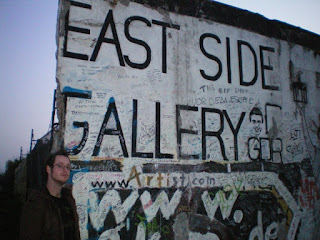


I have been struggling with writing this post from the moment we flew back in to Edinburgh. And not for lack of inspiration.
Berlin is amazing. There really is something incredibly sexy about a city that has been rebuilding and renewing itself for over 60 years... Something dynamic, something very vibrant and alive. Berlin is the embodiment of a city with a truly genuine lifeforce that exists and breathes at the core of every building, every park, every citizen of this magnificent town.
So no, inspiration is definitely not a problem.
We spent an entire day on a cycle tour of the city, stopping to take in pieces of history (from Babelplatz, where Hitler held book burnings, to Checkpoint Charlie, where Russian and American tanks faced off through a small gap in the Berlin wall, all the way back to the Brandenburg Gate, which Napoleon's armies marched through in 1806), enjoy a beer and a bratwurst in a beer garden, and soak in some of the glorious weather that graced most of our trip.
There was a day of sunburn out in Potsdam, ambling between a series of beautiful palaces set in a sprawling manicured park which was just beginning to burst with the life of Springtime.
The Jewish Memorial for victims of the Holocaust moved many to tears, and left us silent for an age. Stories of misery and daring escapes sparkled in my mind as I walked through The House at Checkpoint Charlie, a museum dedicated to the people's struggles against (and through and over and under) the Berlin Wall.
My stomach enjoyed every moment of the fine international cuisine, as did my wallet enjoy the reasonable prices offered for great food and friendly service to match.
And the sunshine... Oh the sunshine! I spent 4 of our 6 days in just a t-shirt, with a very light jumper for the mornings and evenings. In fact, we spent almost 2 hours of our first day in Berlin just dozing on the grass in front of some of Berlin's finest old buildings, watching students stretch out with books, basking in the sun's warmth, and listening to the loud singing of some young Italian tourists.
You see, there is just so much to write about! And then there is the city itself, regardless of our travels.
A city that is almost 800 years old, which has served as the capital city of some of the world's most influential nations - from the proud Kingdom of Prussia, to the powerful German Empire, to modern-day Germany - Berlin is a city with a unique history and an enrapturing story. The Brandenburg Gate hosted Napoleon, saw the return of successful Prussian armies, farewelled troops of the German Empire into World War I and II. The Reichstag survived through the tumultuous times of the Weimar Republic, only to be gutted by a fire during Hitler's rise to power at the head of the National Socialists, and then stood dormant, powerless, watching the rapid rebuilding and then the devastating destruction of the city around it as history took her course. Potsdamer Platz was once Europe's busiest traffic intersection before it was practically cleft in two by opposing ideologies occupying opposite halves of one city.
And still the people of Berlin survived. Berlin's wounds are fresh, and her scars are deep, and the pain of the past is visible everywhere you turn. But the scars are beautiful, the wounds are closing over, and the pain is healing, leaving behind a trail of character, learning and progression. And today the people of Berlin continue, shaped by an incredible past, and moving forwards in an equally unique direction.
Anyone visiting Berlin would find themselves filled with inspiration. You could walk the streets of Berlin blindfolded and still come home with stories to tell. You could block out all the sounds of the city and still return singing the praises of one of Europe's most special places.
But how do you even begin to do it in such a way that does justice to this strangely encompassing experience?
That is the thing about Berlin. It is an experience. And there is no way that words or pictures, alone or combined, could do it justice. I cannot think of a single medium which can convey the soul-touching energy of Berlin.
All I can do is beg of you, each and every one of you, please, please visit Berlin. Actually no, don't visit it. Berlin isn't a place to be visited. It is a place to be challenged, to be given a chance, to be congratulated, to be breathed in, to be seen, to be experienced. I can guarantee that you will walk away with something in return.
Berlin may be financially poor. But she really is oh so sexy, in all the best and worst ways.


Monday, March 23, 2009
Get outta town!
Since our return to Scotland in January, we have essentially been living in the same three or four streets for almost 3 full months. Life involves scampering from home to work to home, with an occasional stop at a cinema, cafe or pub. I didn't realise how depressing it was until about 6 weeks of the same old search for safety, coveting the comfort of the inviting indoors (how's that for alliteration!).
In the past few weeks I have come to fully appreciate the validity of the age-old cliche of a city 'coming back to life'. I have witnessed this phenomenon with my own eyes. The nicest part about the transition from winter to spring so far hasn't necessarily been the weather itself (although the lingering warmth of proper sunshine fills my heart with proper joy), but more the change in people.
Winter is a time when we feel as though there is no option but to hunker down, wrap up and try to outlast the extremes of nature. It is rather like a battle forced upon us - be it a fight against the wind and ice on your unfortunately-necessary walk to work, or a tussle with the creeping cold clutching at your toes as you huddle under the (seemingly thin) blanket at night.
There was nothing to do but to fight it and survive.
But Spring is the returning of choice.
People here can now decide for themselves whether they want to rush to work in a lighter jacket, or mingle a little longer and try to lap up the sunshine; we can now choose whether we would rather wear socks to bed and kick them off in the night, or have cool toes until the bed warms as we doze off in comfort.

It is the choice alone that seems to be making people so much happier. I know for a fact that some are still choosing to spend their time indoors, close to a radiator or a warm oven, or in their favourite coffee shops, waiting for the full-fledged fun of summer - and they are happy just knowing that they could still step outside and it wouldn't be so bad. But others are choosing to linger a little longer in the streets, still wrapped in jacket and scarf, but smiling as the sun touches their face or watching mesmerised as the light dances off windows and puddles and the glasses and jewellery of people walking by. And they are happy that they can now linger, that they can now look up and smile, and can still go home to the comfort of a cosy chair and a cup of tea. You see, in winter we don't even have the choice of looking up - to risk your chin rising from your chest is to risk a blast of freezing air running unabated down the front of your jacket.
Now that it is Spring we can look each other in the eye again. Or not, as is our choice.


Yesterday Spring presented us with a choice - we could remain sheltered in our three streets of Edinburgh, knowing that we were never far from the safety of a warm drink or the calm of a cafe. Or we could grab at the sunshine, step out of the beloved comfort zone, and make something more of the day.
Needless to say, we chose the latter. Our Saturday trip south to Roslin (including the Rosslyn Chapel, Castle and Glen) was wonderfully refreshing, and is hopefully a good indicator of times to come, times which include better weather, more travel and much more choice.


In the past few weeks I have come to fully appreciate the validity of the age-old cliche of a city 'coming back to life'. I have witnessed this phenomenon with my own eyes. The nicest part about the transition from winter to spring so far hasn't necessarily been the weather itself (although the lingering warmth of proper sunshine fills my heart with proper joy), but more the change in people.
Winter is a time when we feel as though there is no option but to hunker down, wrap up and try to outlast the extremes of nature. It is rather like a battle forced upon us - be it a fight against the wind and ice on your unfortunately-necessary walk to work, or a tussle with the creeping cold clutching at your toes as you huddle under the (seemingly thin) blanket at night.
There was nothing to do but to fight it and survive.
But Spring is the returning of choice.
People here can now decide for themselves whether they want to rush to work in a lighter jacket, or mingle a little longer and try to lap up the sunshine; we can now choose whether we would rather wear socks to bed and kick them off in the night, or have cool toes until the bed warms as we doze off in comfort.

It is the choice alone that seems to be making people so much happier. I know for a fact that some are still choosing to spend their time indoors, close to a radiator or a warm oven, or in their favourite coffee shops, waiting for the full-fledged fun of summer - and they are happy just knowing that they could still step outside and it wouldn't be so bad. But others are choosing to linger a little longer in the streets, still wrapped in jacket and scarf, but smiling as the sun touches their face or watching mesmerised as the light dances off windows and puddles and the glasses and jewellery of people walking by. And they are happy that they can now linger, that they can now look up and smile, and can still go home to the comfort of a cosy chair and a cup of tea. You see, in winter we don't even have the choice of looking up - to risk your chin rising from your chest is to risk a blast of freezing air running unabated down the front of your jacket.
Now that it is Spring we can look each other in the eye again. Or not, as is our choice.


Yesterday Spring presented us with a choice - we could remain sheltered in our three streets of Edinburgh, knowing that we were never far from the safety of a warm drink or the calm of a cafe. Or we could grab at the sunshine, step out of the beloved comfort zone, and make something more of the day.
Needless to say, we chose the latter. Our Saturday trip south to Roslin (including the Rosslyn Chapel, Castle and Glen) was wonderfully refreshing, and is hopefully a good indicator of times to come, times which include better weather, more travel and much more choice.


Thursday, March 12, 2009
Navigating the doldrums
It has been cold in Edinburgh for as long as I can remember. The last time I wore just some short sleeves to protect me from the elements was in Barcelona, two and a half months ago.
Without any form of private transportation, it makes it difficult to escape in any way. Sometimes it feels like the city and the weather are holding us all captive - those of us lucky enough might get out and chase some sunshine on the weekends, but the rest of us stay put, lying a bit dormant, navigating the doldrums.
Soon winter will be over, and we'll get out and about once more. Until then, I must make myself content merely dreaming of warmer times past, and even warmer times to come.
Photos from Malaysia were of a great help to me in maintaining the dreams...


Without any form of private transportation, it makes it difficult to escape in any way. Sometimes it feels like the city and the weather are holding us all captive - those of us lucky enough might get out and chase some sunshine on the weekends, but the rest of us stay put, lying a bit dormant, navigating the doldrums.
Soon winter will be over, and we'll get out and about once more. Until then, I must make myself content merely dreaming of warmer times past, and even warmer times to come.
Photos from Malaysia were of a great help to me in maintaining the dreams...


Monday, March 9, 2009
Upcoming
Berlin, early April
Dublin, early May
Motorcycle tour in early autumn? A dream or a possibility?
Dublin, early May
Motorcycle tour in early autumn? A dream or a possibility?
Monday, February 23, 2009
What we leave behind
My mother always used to emphasise how much more enjoyable travelling becomes when you have an understanding of history. I think this played an important role in nurturing my fascination for information on times long (and not so long) past.
Whilst the UK has been an excellent historical experience, Rome was the first true eye-opener for me. Never before had I been confronted in such a way with relics of another age. Even living almost in the shadow of an 800 year old castle in Edinburgh could do nothing to prepare me for the deeper, longer and more thoroughly impressive shadows cast by 2000 year old cities lying in ruins before me.
'It is true that the Romans stole a lot from the Greeks - especially in philosophy and culture. But this is not to say that they produced cheap imitations of Greek social institutions; the Romans often took Greek ideas and built on them until the result was Roman perfection. This is never more evident than in Roman architecture.'
This is a paraphrased (and Anglicised) version of the opening blurb given by our Italian tour guide whilst we sheltered under one of the many archways of the Colosseum. It was pouring rain, and tourists were busy dodging shady-looking Bengali men chasing them with 'Cheap umbrellas! I give you good deal!'
All that I could think about was the history that lay literally beneath my feet. How many people had sheltered themselves beneath this colossus in the middle of an ancient city? If I could have travelled back in time over 1800 years, who would I have found standing in exactly the same position as I was then? What would they have looked like, what would they have been thinking? Would they have been as awe-struck by this amazing feat of human ingenuity? Would they have known that I would be standing in their place in 1800 years time? Would they have known to be proud of this structural feat?
'Romans tended to appreciate the Greek architecture, but did not appreciate the limitations that it presented. As the Greek structures were limited to square shapes, their height was also severely limited - there is only so much weight that the top of a square can bear. So the Romans invented the arch. The archway distributes the weight far more evenly, and allows for structures as tall and magnificent as this one - still standing proudly in the middle of a city that has changed endlessly around it; still striking awe and wonder in the eyes and minds of each and every person who sees it for the first time.'
After spending five days completely immersed in the enduring beauty left by a civilisation that perished over a thousand years ago, I was left with two thoughts predominating:
After so much time with my mouth gaping, would I still remember how to keep my bottom jaw from dragging along the ground?
After a thousand years, what would be left for our civilisation to be proud of? What have we produced that would last ages beyond us and give future generations as much as what previous civilisations have left for us?
Back in London for Christmas, I began searching for some sort of a sign that our epoch in history would provide an equally enduring mark as the Roman era did. Circling the Gherkin whilst looking for Spitalfield Markets on the East side of the city was as about as inspiring as staring across Circular Quay at the Toaster in Sydney. I was gradually resigning myself to the fact that there won't be much left behind when our time here ends and the next great period in the history of the world begins.
And the more that I thought about it, the less I liked this. I wanted to be a part of an era that I could be proud of. I wanted someone to be standing in my footsteps in 2000 years and wondering who I was, what I was thinking, what I looked like. (Me, me, ME!)
Somehow I doubted that a building like the Montparnasse Tower (which I wish I hadn't seen whilst) in Paris would last a few measly centuries, let alone making it through multiple millennia.
As all hope was about to disolve into complete despondency, I made my first visit to the city of Barcelona and saw my first Gaudi.
Antoni Gaudi's architecture is beyond words.
Only Gaudi managed to assuage my growing fears that my peers would leave nothing behind.
Gaudi was an architect who would push all engineering boundaries in order to live out the inspirations that he saw in nature. His designs not only paid tribute to the natural world in their style, but also attempted to incorporate a philosophy of natural living in their functionality.
For example, sitting under the branching pillars of the Sagrada Familia (Gaudi's unfinished masterpiece - an enormous Gothic cathedral which is still under construction), you get the same feeling of peace and tranquility as you would from sitting under the protective canopy of an ancient forest. I was sitting, effectively, in the middle of a construction site, yet I still found myself wanting to open my eyes wider, sink deeper into the floor, speak in whispers and ingest the very essence of the room. It was truly inspirational.
It is an intense experience.
Not even pictures can do it justice. The only way anyone could possibly come to appreciate one of his designs is to go and stand right in the middle of it and try not to forget to breathe.
Without dwelling too much more on the experience which is (apparently) beyond description (so why do I keep trying to describe it?), I just wanted to briefly return to my mother. The same mother that told me to learn history so that I may better appreciate the nature of the world around me.
For that lesson, I am eternally grateful Mother Dearest. It is because of you that I undertook a quest not just to enjoy the world, but to see it in a light that improved my understanding of it, in a light that showed me not just the ways to enjoy, but also why it is something to be enjoyed.
What I couldn't quite figure out is why it was so important to me that we leave behind buildings or constructions for the history books - why were the places important? Aren't the stories about who we are enough?
By chance I picked up a book along my travels from an amazing bookstore in downtown Seattle. Originally a gift for another, I found it in my suitcase on my return to Edinburgh and, having nothing else to read, decided that I would flick through the first few pages: The Architecture of Happiness by Alain de Botton. In it, I found my answer...
"Belief in the significance of architecture is premised on the notion that we are, for better or for worse, different people in different places - and on the conviction that it is architecture's task to render vivid to us who we might ideally be."
We will be defined in history not just by the stories that we leave behind, but rather by the physical context in which those narratives can be found.
I hope that my story is found in a thousand years buried deep inside a building designed by a genius like Antoni Gaudi.
Whilst the UK has been an excellent historical experience, Rome was the first true eye-opener for me. Never before had I been confronted in such a way with relics of another age. Even living almost in the shadow of an 800 year old castle in Edinburgh could do nothing to prepare me for the deeper, longer and more thoroughly impressive shadows cast by 2000 year old cities lying in ruins before me.
'It is true that the Romans stole a lot from the Greeks - especially in philosophy and culture. But this is not to say that they produced cheap imitations of Greek social institutions; the Romans often took Greek ideas and built on them until the result was Roman perfection. This is never more evident than in Roman architecture.'
This is a paraphrased (and Anglicised) version of the opening blurb given by our Italian tour guide whilst we sheltered under one of the many archways of the Colosseum. It was pouring rain, and tourists were busy dodging shady-looking Bengali men chasing them with 'Cheap umbrellas! I give you good deal!'
All that I could think about was the history that lay literally beneath my feet. How many people had sheltered themselves beneath this colossus in the middle of an ancient city? If I could have travelled back in time over 1800 years, who would I have found standing in exactly the same position as I was then? What would they have looked like, what would they have been thinking? Would they have been as awe-struck by this amazing feat of human ingenuity? Would they have known that I would be standing in their place in 1800 years time? Would they have known to be proud of this structural feat?
'Romans tended to appreciate the Greek architecture, but did not appreciate the limitations that it presented. As the Greek structures were limited to square shapes, their height was also severely limited - there is only so much weight that the top of a square can bear. So the Romans invented the arch. The archway distributes the weight far more evenly, and allows for structures as tall and magnificent as this one - still standing proudly in the middle of a city that has changed endlessly around it; still striking awe and wonder in the eyes and minds of each and every person who sees it for the first time.'
After spending five days completely immersed in the enduring beauty left by a civilisation that perished over a thousand years ago, I was left with two thoughts predominating:
After so much time with my mouth gaping, would I still remember how to keep my bottom jaw from dragging along the ground?
After a thousand years, what would be left for our civilisation to be proud of? What have we produced that would last ages beyond us and give future generations as much as what previous civilisations have left for us?
Back in London for Christmas, I began searching for some sort of a sign that our epoch in history would provide an equally enduring mark as the Roman era did. Circling the Gherkin whilst looking for Spitalfield Markets on the East side of the city was as about as inspiring as staring across Circular Quay at the Toaster in Sydney. I was gradually resigning myself to the fact that there won't be much left behind when our time here ends and the next great period in the history of the world begins.
And the more that I thought about it, the less I liked this. I wanted to be a part of an era that I could be proud of. I wanted someone to be standing in my footsteps in 2000 years and wondering who I was, what I was thinking, what I looked like. (Me, me, ME!)
Somehow I doubted that a building like the Montparnasse Tower (which I wish I hadn't seen whilst) in Paris would last a few measly centuries, let alone making it through multiple millennia.
As all hope was about to disolve into complete despondency, I made my first visit to the city of Barcelona and saw my first Gaudi.
Antoni Gaudi's architecture is beyond words.
Only Gaudi managed to assuage my growing fears that my peers would leave nothing behind.
Gaudi was an architect who would push all engineering boundaries in order to live out the inspirations that he saw in nature. His designs not only paid tribute to the natural world in their style, but also attempted to incorporate a philosophy of natural living in their functionality.
For example, sitting under the branching pillars of the Sagrada Familia (Gaudi's unfinished masterpiece - an enormous Gothic cathedral which is still under construction), you get the same feeling of peace and tranquility as you would from sitting under the protective canopy of an ancient forest. I was sitting, effectively, in the middle of a construction site, yet I still found myself wanting to open my eyes wider, sink deeper into the floor, speak in whispers and ingest the very essence of the room. It was truly inspirational.
It is an intense experience.
Not even pictures can do it justice. The only way anyone could possibly come to appreciate one of his designs is to go and stand right in the middle of it and try not to forget to breathe.
Without dwelling too much more on the experience which is (apparently) beyond description (so why do I keep trying to describe it?), I just wanted to briefly return to my mother. The same mother that told me to learn history so that I may better appreciate the nature of the world around me.
For that lesson, I am eternally grateful Mother Dearest. It is because of you that I undertook a quest not just to enjoy the world, but to see it in a light that improved my understanding of it, in a light that showed me not just the ways to enjoy, but also why it is something to be enjoyed.
What I couldn't quite figure out is why it was so important to me that we leave behind buildings or constructions for the history books - why were the places important? Aren't the stories about who we are enough?
By chance I picked up a book along my travels from an amazing bookstore in downtown Seattle. Originally a gift for another, I found it in my suitcase on my return to Edinburgh and, having nothing else to read, decided that I would flick through the first few pages: The Architecture of Happiness by Alain de Botton. In it, I found my answer...
"Belief in the significance of architecture is premised on the notion that we are, for better or for worse, different people in different places - and on the conviction that it is architecture's task to render vivid to us who we might ideally be."
We will be defined in history not just by the stories that we leave behind, but rather by the physical context in which those narratives can be found.
I hope that my story is found in a thousand years buried deep inside a building designed by a genius like Antoni Gaudi.
Subscribe to:
Posts (Atom)
